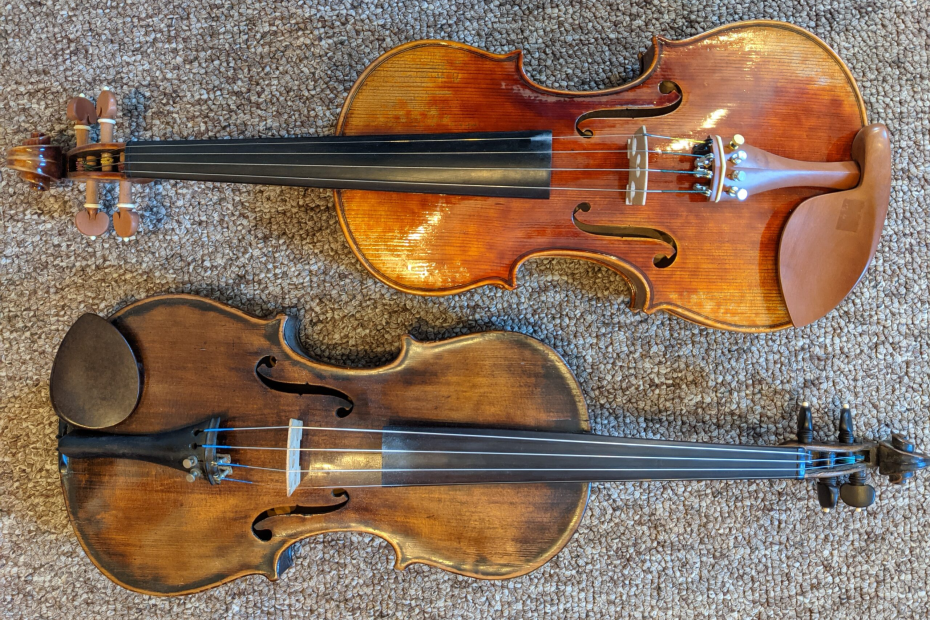
If you’ve ever asked yourself, “What’s the difference between a fiddle vs violin?” you’re not alone. This question comes up all the time, especially for beginners, parents, and musicians who are branching into new styles.
The truth is a fiddle and a violin are the same instrument. The difference is how they’re played and the style of music — not the instrument itself.
This post breaks down the real difference between fiddle vs violin, and the history behind their names.
Where the Words “Fiddle” and “Violin” Come From
Before we talk technique or music styles, it helps to understand the history. The word violin comes from classical European traditions. It’s tied to formal training, orchestras, and written music. When people hear “violin,” they often picture concert halls, black attire, and sheet music on a stand.
The word fiddle has older roots and shows up across many cultures. It became commonly used in folk traditions (especially in Irish, Scottish, Appalachian, bluegrass, and old-time music). When people hear “fiddle,” they tend to think of dancing, storytelling, and music passed down by ear.
Same instrument, different associations. The names just grew up in different musical spaces.
Interested in learning the basics of how a violin/fiddle is played? Read “How to Play Violin” now.

The Instrument Itself: Exactly the Same
This part surprises a lot of people.
There is no physical difference between a fiddle and a violin. Same size, same strings, same tuning (E-A-D-G), same parts (bridge, body, sound post, neck, etc). If you walked into a shop and picked up an instrument labeled “violin,” that same instrument could be used as a fiddle without changing anything.
If you want a breakdown of the parts of the violin (or fiddle, same difference), check out this labeled diagram.
Sometimes players make small setup adjustments like flatter bridges or different string choices, but those are personal preferences, not defining features. Fiddlers opt for steel strings and flatter bridges for easier double stops (playing two notes at once) and a more cutting sound. Classical violinists usually prefer strings with a synthetic core, and violins with a warmer tone.
So if you’re wondering whether you need a different instrument for a fiddle vs violin, you don’t. You already have what you need.
The Real Difference: Style and Approach
The biggest difference between fiddle vs violin comes down to how the music is played, not what you’re holding.
Classical violin playing usually focuses on:
- Precise technique
- Consistent tone
- Following written music
- Blending with an ensemble
- Controlled vibrato and phrasing
Fiddle playing usually focuses on:
- Rhythm and groove
- Playing by ear
- Ornamentation and variation
- Danceability and energy
- Personal style over perfection
These key differences between a fiddle vs violin are why performances associated with each vary so much. The way a musician moves, acts, and plays in a performance depends on what style they are playing in. Neither approach is better, they just value different things.
They require different skills, and both take real work.
Sheet Music vs Playing by Ear
This is one of the most noticeable differences people feel when comparing fiddle vs violin.
In classical training, sheet music is central. You’re taught to read notes, follow markings, and recreate what’s on the page as accurately as possible.
In fiddle traditions, learning by ear is common. Tunes are shared through listening, repetition, and memory. You might hear the same tune played ten different ways (and that’s normal). This doesn’t mean fiddlers can’t read music or violinists can’t play by ear. Many musicians do both. But culturally, the emphasis is different.
If you grew up being classically trained, learning fiddle music can feel freeing — and a little uncomfortable at first. If you grew up playing fiddle music, classical music can feel structured — and sometimes intimidating.
Both will push you, and that’s a good thing. Many violinists will play classical, fiddle, and modern music as they learn and grow as musicians.

Technique Differences
People often assume fiddle technique is “looser” or less formal.
Yes, fiddlers may use:
- Less vibrato
- More slides and ornaments
- Faster bow changes
- Rhythmic bow patterns
But those choices are intentional. They serve the style.
Good fiddle playing still requires:
- Clean intonation
- Strong bow control
- Endurance
- Musical awareness
The technique just aims at a different outcome.
And here’s something important:
Many of the best fiddlers started with classical violin training.
That foundation doesn’t disappear. It adapts.
Sound and Tone: Perfection vs Personality
In classical violin, players often aim for a polished, even tone that blends well with others. Consistency matters.
In fiddle music, tone can be rougher, brighter, or more raw — on purpose. The goal is expression, drive, and feel.
That doesn’t mean sloppy playing. It means character matters more than flawlessness.
When people argue about the sound differences between a fiddle vs violin, they’re usually reacting to style, not skill.
Is One Harder Than the Other?
This is a common question — and an unfair one. The truth is, difficulty depends on what you’re used to, not as much one style being actually harder than the other.
Some of the most challenging music I’ve ever played has been fiddle music, with excessive chords, double stops, and high jumps and shifting. Conversely, some classical or modern music I’ve played have been extremely hard, with challenging techniques or technical passages.
Classical violin can also be hard because:
- The standards are extremely high
- Small mistakes are noticeable
- Repertoire is technically demanding
Fiddle can be hard because:
- You’re responsible for rhythm and groove
- You often lead instead of blend
- There’s less written guidance
- You have to trust your musical instincts
They challenge different parts of your brain and body, and are both hard for different reasons.
Can You Switch Between Fiddle and Violin?
Yes. And many musicians do.
Switching between fiddle vs violin styles can actually make you a stronger player overall. You develop better rhythm, better listening skills, and more flexibility. Most people I know have played all types of music, and they are better musician for it.
The key is understanding the context. What works in one style doesn’t always translate directly to the other, it just depends on the song. You won’t catch a seasoned violinist playing a Tchaikovsky the way you play Vivaldi. Or be playing a Bach like you play Copland’s “Hoe-Down”.
Music isn’t about staying in one lane forever, and switching up styles is fun as well as essential to develop well-rounded skill set.
What Should You Call Your Instrument?
Here’s the honest answer:
Call it whatever feels right.
If you’re playing Bach in an orchestra, “violin” makes sense.
If you’re playing folk tunes with friends, “fiddle” fits.
Some musicians use both words depending on the setting. Some stick with one. None of them are wrong. I personally have always said my instrument is a violin if anyone asks, because that’s what I have grown up calling it, and I am classically trained.
But this is where a some pressure comes from — the idea that choosing one label locks you into an identity.
It doesn’t. You’re allowed to explore, and you should.
If You’re a Beginner (or a Parent), Here’s What Matters Most
If you’re just starting out, the fiddle vs violin debate doesn’t need to guide your decision. They are the same instrument physically.
What matters more is:
- Do you enjoy the sound?
- Do you like the music you’re learning?
- Do you feel motivated to practice?
You can start with classical lessons and later explore fiddle. Or start with folk music and later learn classical technique. Access to resources and lessons for these styles can also depend on your location, so that might influence your decision on where to start learning.
But there’s no wrong order,
The Bottom Line
So, what’s the difference between a fiddle and a violin?
Physically: nothing. Any physical differences in a “fiddle” vs a “violin” are a personal preference of the musician playing the instrument, not a generalized distinction in structure or look.
Musically: style, tradition, and energy. The many different types of music that can be played by this instrument are astounding. The way the music you play will sound will depend on the style, and will also affect the way you move, and the energy you want to project.
That’s the beauty of the instrument — there are so many different composers, songs, and techniques to explore as you learn and grow.
And if you love playing, whether you call it fiddle or violin, you’re doing it right.